The Video Wall Decision
When businesses in Singapore plan a large-format display installation — whether for a corporate lobby, retail flagship, or command centre — the conversation inevitably comes down to two technologies: LED video walls and LCD video walls. Both can deliver stunning visuals, but they differ significantly in construction, performance characteristics, and total cost of ownership.
Understanding these differences is essential to making an informed investment. This article provides a detailed, objective comparison to help you choose the right technology for your specific application.
How They Work
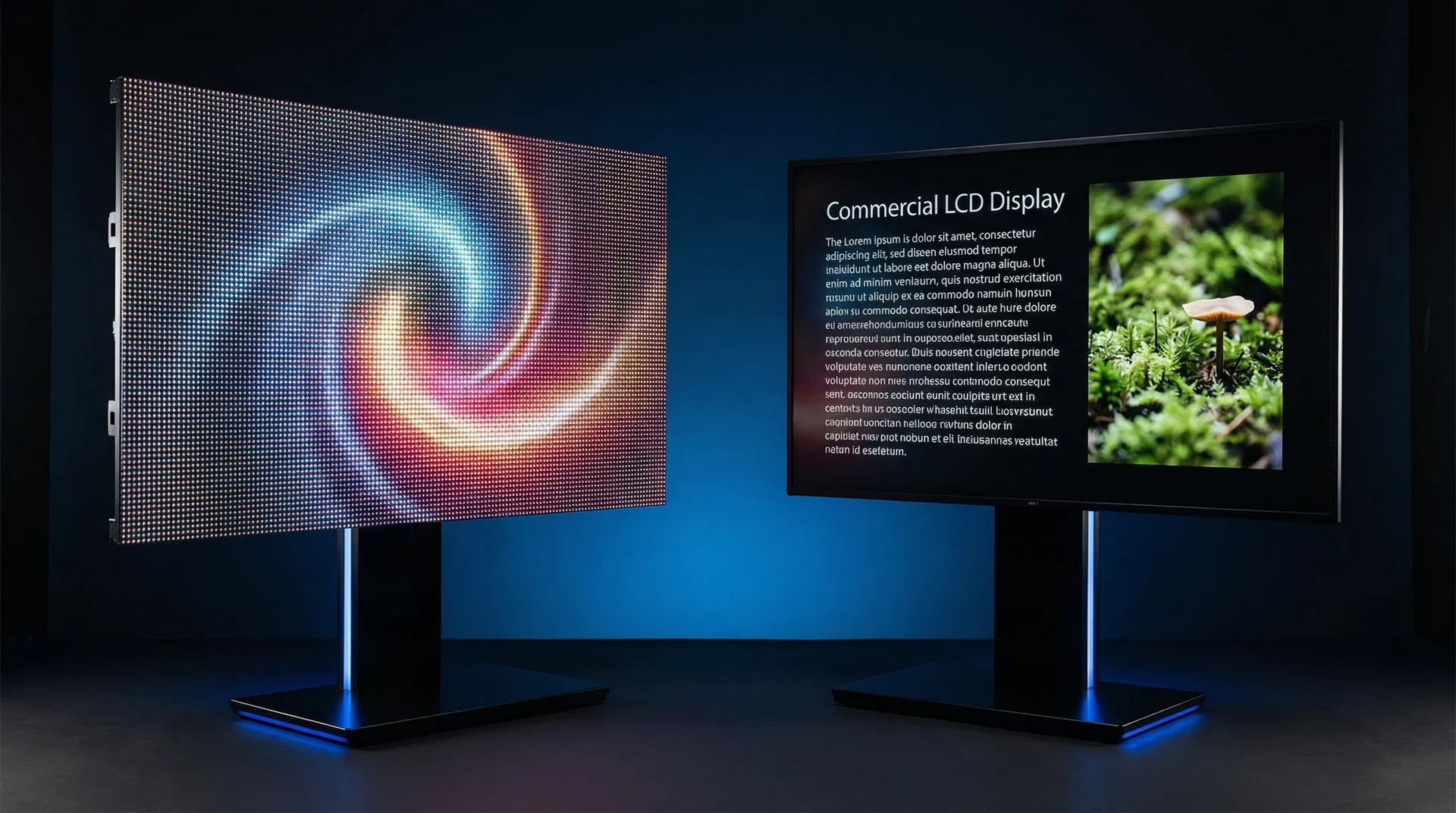
LCD video walls consist of multiple individual LCD panels (typically 46-inch or 55-inch) arranged in a grid and driven by a video wall controller. Each panel has its own backlight, liquid crystal layer, and colour filters. The key limitation is the bezel — the physical frame around each panel. Even with ultra-narrow bezel technology (as thin as 0.88mm per side), the seam between panels remains visible, creating a subtle grid pattern across the display surface. LED video walls are constructed from modular cabinets containing thousands of tiny light-emitting diodes. Each LED serves as an individual pixel (or sub-pixel), meaning there are no bezels or seams. The result is a completely seamless display surface that can be built to virtually any size or aspect ratio. The pixel pitch — the distance between the centre of adjacent pixels, measured in millimetres — determines the resolution and optimal viewing distance.Brightness and Viewing Conditions
LED video walls typically offer significantly higher brightness levels, ranging from 600 to 1,500 nits for indoor models and up to 10,000 nits for outdoor installations. This makes them ideal for environments with high ambient light, such as retail storefronts, exhibition halls, and outdoor venues.
LCD video walls generally produce 500 to 700 nits of brightness, which is more than adequate for controlled indoor environments like corporate boardrooms, control rooms, and indoor retail spaces. Their anti-glare coatings and consistent colour reproduction across the entire panel surface make them excellent for displaying detailed content like data dashboards and fine text.
Resolution and Viewing Distance
For close-viewing applications (under 2 metres), LCD video walls have a natural advantage. A standard 55-inch Full HD LCD panel delivers a pixel density of approximately 40 pixels per inch (PPI), ensuring crisp text and detailed imagery at arm's length. To achieve comparable pixel density with LED, you would need a pixel pitch of 0.9mm or smaller, which significantly increases cost.
For viewing distances of 3 metres or more, fine-pitch LED (P1.2 to P2.5) delivers excellent visual quality without the distraction of bezels. At these distances, the individual pixels become indistinguishable, and the seamless surface creates a more immersive viewing experience.
Cost Comparison
The cost equation has shifted considerably in recent years as LED manufacturing has matured. However, LCD video walls still offer a lower entry point for many applications.
A typical 2x2 LCD video wall (four 55-inch panels with ultra-narrow bezels) costs approximately SGD 8,000–15,000 including the video wall controller and mounting hardware. The equivalent display area covered by a P1.5 fine-pitch LED video wall would cost SGD 25,000–45,000.
However, when scaling to larger sizes (3x3 and beyond), the cost gap narrows. LED video walls also have lower long-term maintenance costs because individual LED modules can be replaced without affecting the rest of the display, whereas a failed LCD panel requires replacing the entire unit.
Lifespan and Maintenance
Both technologies offer excellent longevity when properly maintained. Commercial LCD panels are rated for 50,000 to 70,000 hours of continuous operation. LED video walls typically achieve 100,000 hours, though brightness may gradually decrease over time (a process known as LED degradation).
LED video walls offer a significant maintenance advantage: front-serviceability. Individual LED modules can be swapped out from the front of the display without dismounting the entire wall. LCD video walls require rear access for panel replacement, which can be problematic in installations where the wall is flush-mounted.
Which Should You Choose?
Choose LCD video walls when:- Your viewing distance is under 2 metres and you need pixel-perfect detail
- You are displaying data-heavy content like dashboards, spreadsheets, or surveillance feeds
- Budget is a primary constraint for a smaller installation (2x2 or 2x3)
- The installation environment has controlled lighting
- You need a seamless, bezel-free visual experience
- The display will be viewed from 3 metres or more
- You require high brightness for retail or semi-outdoor environments
- You are building a large-scale installation (10+ square metres)
- Creative content and brand impact are the primary objectives
The Goodview Advantage
Goodview manufactures both LCD video wall panels and fine-pitch LED video wall systems, giving us the unique ability to recommend the right technology based on your specific requirements rather than pushing a single product line. Our Singapore team can arrange a side-by-side demonstration at our showroom so you can see both technologies in person before making your decision.
Contact us today to schedule a consultation and discover which video wall technology will deliver the best return on investment for your business.